Tuesday, 30 August 2011

Blonde or Brunette?

Gentlemen prefer blondes. But they marry brunettes. Blondes have more fun... Etc etc etc. Many times I've wondered whether these clichéd sentences were true - or had some truth to them. When asking my blonde friends (who, for the record, are not dumb) if they did have more fun, the only answer I got was "er, I don't know... How is it like to be a brunette?". Most of the boys I know don't really have a preference between brunettes and blondes; they will not mind hair colour as long as the girl is smart, nice and cute. And I'm not married to some monocle-wearing diamond mine owner who used to prefer blondes. Is it not true then what they say about blondes and brunettes? So why do we actually give moral and narrative meanings to women's hair colour?

For Roman women, being blonde was the sign of a high social rank (which is why many of them dyed their hair with a mixture including animal's pee). Preraphaelites used strawberry blonde models to portray languid, sickening beauty. The fact that Manet's cheeky Olympia was a brunette is no coincidence: for a long time, brunette was synonym with temptress and vamp. During the XXth century, Hollywood channeled best the collective thoughts on women and their hair tones.

With bubbly blonde Ziegfeld-Follies-golddigers and Anita Loos's masterpiece Gentlemen Prefer Blondes, soon in the 1930's roles were inverted, and blonde bombshells like Jean Harlow went out and had a ball while brunettes like Barbara Stanwyck stayed in and... oh wait, Barbara Stanwyck also did go out and have a ball. Now that I think about it no one wanted to stay in playing the good little wife in the 30's. They were right.
Later, in the 40's, colour codes changed a bit: usually blondes were the seductive, ambiguous and fun ones (Veronica Lake and Marlene Dietrich) while brunettes were the mysterious, feline, evil ones (like Ann Blyth in Mildred Pierce- you just have to watch that movie!- or Gene Tierney in... most of her films). There was also a new category, the fiery redhead. And if your personality didn't match your hair colour, you could just dye it!

Rita Hayworth went from redhead to blonde for The Lady From Shanghai but nobody liked the change. So do gentlemen really prefer blondes?
In the fifties there was of course Marilyn (and a thousand Marilyn wannabees), but at the same time...

...Doris Day became a symbol of all the Peggy Sues and Sandy Olsens in America.

While the new brunette icon, Sofia Loren, was so much of a sex bomb that she actually scared men.
It seems so strange how the codes keep changing; and depending on the decade and your hair colour you're in turns supposed to be a good wife, a witch, a sex goddess and an innocent schoolgirl. And the public never fails to recognize the hair's meaning, no matter how much eras change. Ultimately, I guess the division of the world between "blondes" and "brunettes" is nothing but an aesthetic reflection of the long established (and very chauvinistic) idea that there are two types of women: the marrying kind and "the others". I'm not going to make a feminist speech here -I confess I do have a lot of fun with the whole good woman/fallen woman deal- but has anyone ever seen men divided in blondes and brunettes, each being given a set of inherent characteristics?
Anyway talking about gentlemen... there was one who very clearly preferred blondes: when asked about his leading ladies' hair colour, Alfred Hitchcock replied "blondes make the best victims. They're like virgin snow that shows up the bloody footprints". Be as it may, Hitchock's distant, regal blonde heroines are now true icons.


On the other hand, Davind Lynch, even if he often gives leading roles to stunning blondes, he always focuses his fascination on mystery brunettes, usually passionate, dangerous and dramatic.


I think after all I agree most with Mr. Lynch's opinion that "there is a blonde and a brunette inside every girl". What do you think?

Saturday, 27 August 2011

The F Word


A couple of days ago I came across this video of John Galliano's S/S 1997 show. As I melted with joy watching it, it dawned on me how much of a visionary Mr. Galliano is: this collection is just as wearable and fantastic now as it was 15 years ago (personally I would give anything for some of those embroidered silk palazzo pants and those silver-fringed scarves). Dior has now lost the most talented designer the brand ever had. And even if it signs Marc Jacobs as the new art director (which might work very well on the economic level- provided Mr. Jacobs can stand the pressure on the long run), the magic, glitz and high drama (as well as the immense knowledge of fashion history) for which we have known Dior for the last fifteen years (a lifetime in fashion) will be no more.
Well thank God there are at least these old videos on YouTube! Looking at Kate laughing, Nadja shaking it and Naomi walking like a panther I remembered that hey! fashion used to be cool, it used to be about fun, glamour and dreaming! Whatever happened? When did the fashion industry turn into yawn industry? When did fun-loving models turn into librarian-looking creatures too concentrated in trying not to fall from their 20 cm heels to fully seduce the public? And what about fashion insiders? Nowadays it's all about stylists and editors wearing gothic-punk hype labels and a bored expression, too darn modern to laugh or even smile. Everyone complains about fashion weeks being so busy and meaning so much work, but I can tell you if every show was like this one we would all forget about our duty to look fabulous for the heaps of bloggers photographing us at the entrance of shows, simply being thrilled by the collections instead.
Unfortunately, with Monsieur Saint Laurent and Alexander McQueen gone, Christian Lacroix out of business and Galliano himself disgraced, we can only rely on Jean-Paul Gaultier and Sonia Rykiel for the much-needed fun and hope they will never retire. Of course time goes by and things happen, people sadly pass away, go bankrupt or accidentally destroy their careers; economical disasters take place and new ideas appear. I love some of the new concepts going on in fashion these last few years, some of the new designers are seriously talented and innovative. But I think in the midst of the crisis, the bleak prospects and the angst, young people (especially young people!) want to be reminded of how life can be fun and fabulous in spite of it all. So down with the furrowed brow: bring back the fun to fashion!

Saturday, 6 August 2011

Chelsea Girls (and Boys)


"Everybody passing through here is somebody, if not in the outside world": Patti Smith's memories of the Hotel Chelsea (which she called "her home") are filled with excitement and the rare energy of a place that has witnessed the everyday lives of many icons of the XXth century. Actually before: Mark Twain was said to have stayed at the Chelsea, as well as some of the Titanic's survivors, which were brought there after the catastrophe. But the Chelsea is really synonym with New York's art avant-garde as well as sex, drugs and rock & roll. And the fact that the hotel is closing its doors today for the first time ever is somewhat heartbreaking. It might open again in some time, but right now it feels like the bleak confirmation that a whole era has ended. One thing is certain, though: the guests and the stories at the Chelsea, which gave the hotel its extraordinary spirit, will live on.

Patti Smith and her once roommate Robert Mapplethorpe were snapped at the hotel's fire stairs.

Bob Dylan wrote many of his most successful songs during his stay at the Chelsea. Here he is photographed in his room.


Then of course there were the Factory people. Andy Warhol was the one who started the mitification of the place with his film Chelsea Girls. Not all of the girls in the movie lived there, but they did spend a great deal of time. Edie Sedgwick did take a room, in which she once started a big fire (here she is snapped afterwards, with a hand in bondage). She used to start little fires with the candles she liked to light everywhere around the room. I once heard that Leonard Cohen, when coming into her room and seeing the candle arrangement, warned her it would bring her very bad energy. She didn't believe it.

Here's a picture of Mr. Cohen. He wrote Chelsea Hotel #2, a crude and beautiful song to Janis Joplin.

Janis also lived there, obviously. Here she is in front of the main door, on West 23rd Street.

Also, here is Dennis Hopper with Terry Southern.

The Chelsea was big during the punk era and the CBGB days. Dee Dee Ramone stayed there; the place inspired him to write Chelsea Horror Hotel: A Novel.

Around the same time took place the most famous incident of the hotel's story: the violent death of Nancy Spungen, Sid Vicious's girlfriend. I wonder what their life was like at the Chelsea.

Steven Meisel shot many of the photos in Sex in room 822, with Madonna, who had lived there years before.
Of course, there were many more stories and people who passed by the hotel, some notorious, some private. The place was never really very touristy, and it was unchanged, so it kept its authenticity. I just think it's a shame to cut short a story so long and meaningful.

Tuesday, 2 August 2011

Yummy

Just a little reminder of how chic one can look... even just wearing a potato sack!

Wednesday, 27 July 2011

Rainbow Club

Rummaging through my dressing room the other day, I came across an old discarded Benetton tye-dye rainbow-printed bikini I had bought ages ago (I think Oliviero Toscani was still shooting Benetton campaigns back then) and I came to a conclusion: rainbows are back in fashion! Rocking my new favourite bikini and seeing life through a new prism, I've come to realize rainbows are everywhere lately, mainly in Christopher Kane's ab fab cruise 2012 collection.

But rainbows have been a recurrent inspiration subject in fashion for a long time; I can think of the incredible, timeless Carmen Miranda wedges by Salvatore Ferragamo, designed back in 1936 but still super hot and covetable.
Or Alexander McQueen's milefeuille siren dresses. Breathtaking, n'est-ce pas?

Rainbows also make me think of Edie Sedgwick's post-60's style, when she went from minimal black-and-white to psychedelic multicolour with a fantastic long rainbow dress she wore in the last few scenes of Ciao! Manhattan, when she gets her electroshock therapy (I could not find any images of the dress, but you should watch the movie, it's quite something).
Here are some of the other rainbows I've seen around lately:

You can get great rainbow nails and rainbow hair at Wah Nails and Bleach London respectively for a really fashion forward look,

or Comme des Garçons perfume for a rainbow scent!

Or even rainbow decals for your keyboards (available at design-milk.com).


Now it's time to pump up the colour; will you be wearing the rainbow look this summer?

Thursday, 21 July 2011

I Want Candy


Now that I'm almost on holiday all I can think of is delicious Spanish food! And that's one of the reasons why I was so happy to see these short films about Ferrán Adriá's restaurant El Bulli in Nowness (absolutely essential culture & style website by the way). To me, Adriá is one of the best universal Spanish symbols; I think all the people from my country are really proud of him: he is smart, he is positive-thinking and he is creative. Many people think all he does is nouvelle cuisine, but he goes so far beyond that! His incredible, 47-course molecular menu often reminds me of Salvador Dalí's latest paintings (in which he divided everything into molecules). Like Dalí's (rather edible) art, Adriá's cuisine is surprising and surreal. It needs to be tried!
Although none of us will be going to El Bulli in the next couple of years. The Catalan restaurant is closing its doors for research (I guess Ferrán Adriá doesn't want to be one of those arrogant luxury chefs who still use the same recipes as in 1984) and it will open only when some interesting results are reached. It's all about artfulness, finesse and excellence for Ferrán- if only all the other industries in Spain were like that- and El Bulli's food is definitely a universal language, a celebration of taste and life.

Friday, 8 July 2011

Couture Aesthetics

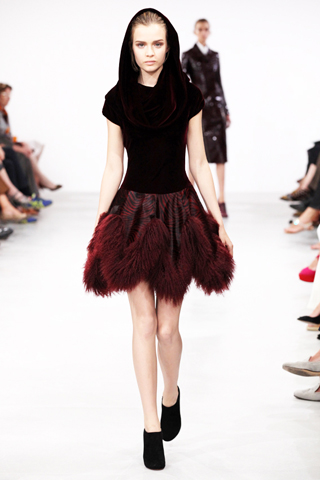
I'm rather excited about this last Couture fashion week: it has had unexpected highs (Giambattista Valli's first collection) and lows (Dior's trademark without Galliano seems to be somewhat lost), new collections by long-established industry members (I'm talking Azzedine Alaïa) and... lots of XIXth century references. And not the obvious crinoline-cum-corset ones!
Most designers seem to have reflected, one way or another, upon the Aesthetic movement that started in Britain in the 1860's and its femininity ideal. Dark, mysterious and primal yet languid and pure creatures were the main characters of Rossetti, Draper or Whistler's paintings- and of this season's catwalks. I mean... all that dramatic velvet!


Valentino


Alaïa

The Crystal Ball, John William Waterhouse

Alexis Mabille

Chivalry, Francis Bernard Dicksee

Jean-Paul Gaultier

It's all about preraphaelism and a mythologic and slightly medieval-tasting version of the XIXth century with a dark, romantic mood...


James McNeil Whistler


Chanel


Alaïa

Jean-Paul Gaultier

And about the sultry sexuality in Aubrey Beardsley's fabulous drawings.


Alaïa


Valentino


Alexis Mabille

Lots of nature-provided drama...


Mourning for Icarus, Herbert James Draper


Giambattista Valli

And of course the utopic virginal femininity of the heroines of aestheticism.


A Sea Spell, Dante Gabriel Rossetti


Valentino


The Little White Girl, James McNeil Whistler


Givenchy


Valentino

So much drama, theatricality and strangeness... I die!


Ophelia, Millais


Valentino